Budget Time Is Coming

Its that time of year again.

No, not Halloween…thats over.  Not Christmas time either.  Its 2013 BUDGET TIME.

Now these words normally spread fear in the hearts and minds (and therefore changes the sleeping patterns) of elected officials but its a very important time of the year.  If youve been reading the local papers, other Halton area municipalities are beginning their budget discussions.  Just today, there was an overview of the Halton 2013 budget presented to regional council and should be made available online today www.halton.ca/budget for public view.

The Town of Milton budget will be available a little later this month on November 26th…unless they get it ready sooner.  Id much prefer to have it available earlier as to give members of council and the public time to go over some of the major projects underway.  The town does have budget call reports throughout the year as Ive posted on my blog many times and this is the final budget to be reviewed before the meeting on December 10th and 11th.

As I outlined on my Twitter feed earlier today from the Regional Council meeting, here are some of the highlights of the 2013 Halton budget overview.

* Long term plan for Halton might be increases at or around rate of inflation. Provincial cutbacks might throw curve ball in future years.

10:17 AM – 14 Nov 12

* Clr Meed Ward asking what can future years increase look like for Halton & sites her experience in Burlington with spiked tax inc’s.

10:16 AM – 14 Nov 12

* Are we preparing for more download from province of services due to their financial condition at the Region of Halton?

10:14 AM – 14 Nov 12

* Reg Clr Meed Ward is concerned about the “party being over” for 0% increases. Inflation right now roughly 1.8% now.

10:08 AM – 14 Nov 12

* Reg Clr Colin Best asks questions re MPAC to ensure speed of new assessments. #MiltonON growth closer to 8% rather than 1.5% region wide.

10:07 AM – 14 Nov 12

* Region of #Halton continues to have a triple A credit rating

10:04 AM – 14 Nov 12

* 66% of $3.9 B in growth related infrastructure all funded by development charges #Halton

10:03 AM – 14 Nov 12

* Timing of project depends on allocation programs in 2013 and beyond. #Halton

10:02 AM – 14 Nov 12

* On the Capital side $3.9 B ten year program for transportation, waste management projects etc…#Halton

9:59 AM – 14 Nov 12

$584K for new waste diversion programs to increase life of the landfill which is “the most important asset of the region of #Halton

9:55 AM – 14 Nov 12

Rate impact for #Halton ends up being zero due to GTA pooling savings.

9:54 AM – 14 Nov 12

* Assessment growth is expected to be 1.5% (new prop)#Halton MPAC assessments have been done. If you’ve incr more than avg taxes might go up.

9:52 AM – 14 Nov 12

* Region of #Halton budget to be put online in packet format to help those who use tablets as well.

9:49 AM – 14 Nov 12

SO needless to say the next few weeks will be busy reading these documents, finding out where money is being spent and getting feedback from the public on both the Region of Halton and Town of Milton budgets.  From time to time here on my blog, I will be posting reports and some feedback I have about the budgets and I hope you take time to read them.

For those of you who are interested, there will be a budget “information session” at the Milton Sports Centre on Wednesday November 28th in Room #4 from 7pm to 9pm for you to be able to ask questions and give us feedback and your thoughts on the Milton and Region of Halton budgets for 2013.  Regional Councillor Colin Best, myself and hopefully some more of our council colleagues will be there.  Send me an email mike@mikecluett.ca if youre interested in attending.

Navigating Through The Fog – Part 4 of 4

Lack of autism support frustrates families

Final installment in the four-part Metroland series, Navigating Through the Fog

“It doesn’t have to be the worst diagnosis in the world when your child has autism; it can be that your child has unique needs and perhaps unique abilities that other children don’t have.” – Lizanne Rowe

Resources are available to help families, individuals with ASD

The following is a list of some of the resources, which may help families navigate through the fog of autism.

Erin Oak Kids Centre for Treatment and Development, Regional autism intervention program services provider for the central west region, including Halton Tel: 905-855-3557 • Toll free: 1-877-374-6625 • www.erinoakkids.ca

Hamilton Health Sciences, Regional autism intervention program service provider for the Hamilton and Niagara regions, located at the Chedoke site of McMaster Children’s Hospital Tel: 905-2100, ext. 77315 • Toll free: 1-800-890-2782 • www.mcmasterchildrenshospital.ca

Ministry of Children and Youth Services’, central west regional office, servicing Halton, 6733 Mississauga Rd., Suite 200, Mississauga • Tel: 905-567-7177 • Toll free: 1-877-832-2818

Ministry of Children and Youth Services’, western regional office, servicing Hamilton 119 King St. West, Hamilton • Tel: 905-521-7280 • Toll free: 1-866-221-2229

Autism Ontario Halton Chapter, 4361 Harvester Rd., Unit 9, Burlington • Tel: 905-631-1233 • E-mail: halton@autismontario.comwww.autismhalton.com

Autism Ontario Hamilton-Wentworth Chapter, 533 Main St. East, Hamilton • Tel: 905-528-8476 • E-mail: hamilton@autismontario.comwww.autismontario.com

Autism Speaks Canada, a registered Canadian charity, North America’s largest autism science and advocacy organization Tel: 416-362-6227 • Toll free: 1-888-362-6227 • E-mail: autismspeakscanada@autismspeaks.orgwww.autismspeaks.ca

Missing Links: Filling the Gaps to Autism, 2317 Fairview St., Burlington • Tel: 905-637-0090 • E-mail: info@missinglinks.cawww.missinglinks.ca

blueballoon – Health Services, 3305 Harvester Rd., Unit 6, Burlington • Tel: 905-333-9730 • www.blue-balloon.com

Oakville Success Centre, 1545 Cornwall Rd., Unit 38, Oakville • Tel: 905-844-4144 • Toll free: 1-888-569-1113 • E-mail: cathy@oakvillesuccesscentre.cawww.oakvillesuccesscentre.ca

Woodview Learning Centre, 69 Flatt Rd., Burlington • Tel: 905-689-4727 • E-mail: wcc@woodview.cawww.woodview.ca

The Natural Care Clinic, 460 Brant St., Unit 16, Burlington • Tel: 905-631-0880 • E-mail: info@naturalcareclinic.cawww.naturalcareclinic.ca

Treat Autism and ADHD – Emerging Trend Conference, info@treatautism.cawww.treatautism.ca

Asperger’s Society of Ontario, Tel: 416-651-4037 • E-mail: info@aspergers.cawww.aspergers.ca

Lions Foundation of Canada Dog Guides, 152 Wilson St., Oakville • Tel: 905-842-2891 • www.dogguides.com

Autism Blogs: Blog Nation’s comprehensive network of blog posts on autism, www.autismblogs.com

Katrina Carefoot’s blogs on autism and life, www.asdmom.comwww.ficklefeline.ca@FickleFeline

Somewhere in Ontario, a child would rather line up his toy cars than navigate them through an invisible maze.

Somewhere in Ontario, a mother looks at her child and instinctively wonders. A doctor tells a father they should wait and see.

Somewhere in Ontario, the diagnosis is confirmed — autism spectrum disorder (ASD).

Approximately one in every 100 children lives with autism, a neuro-developmental spectrum disorder that impedes a person’s ability to communicate and make friends.

Statistics indicate up to one per cent of the population is on the spectrum.

The cause of the disorder remains unknown, but researchers believe the secret is in the genes.

With no cure for autism, families affected by the disorder have turned to a variety of therapies that have proven successful in alleviating its wide-ranging symptoms.

But accessing help is easier said than done.

This is the final installment of a four-part Metroland series, Navigating Through the Fog, that attempts to piece together the puzzle of autism.

• • •

“When you get this diagnosis, not only does it rattle your world, but you are given absolutely no direction as to what you can do to help your child.”

Burlington mom, Lizanne Rowe, didn’t know where to turn when her son, Jack, was diagnosed with autism spectrum disorder (ASD). And she’s not alone.

Many families interviewed for Navigating Through the Fog, a four-part Metroland West Media Group series on autism, spoke of the lack of support they received from medical professionals after their child — or children — were determined to be on the spectrum. One Waterdown mom, who requested anonymity for fear her daughter with Asperger’s syndrome would be labelled as special needs and treated differently by her teachers and peers, was at a loss.

Asperger’s syndrome is an Autism Spectrum Disorder (ASD) that differs from typical ASDs in that those who have Asperger’s are generally high functioning.

They can usually speak, and cognitive development is also intact.

Faced with a lengthy wait for treatment, the nine-year-old girl’s blended family would welcome the opportunity to access services tailored for individuals living with autism spectrum disorder, but finding those resources were next to impossible.

“The support for families is non-existent,” said the Waterdown mom. “If there was help, we could have been at a different level right now, where we are coping and happy, and she’s happy.”

Burlington’s Christine Poe had to secure $45,000 to ensure her son, Dorian, would get the last spot available at Burlington’s Woodview Learning Centre. She was left to her own devices to learn of the Flatt Road facility and other supports to help the family.

However, there are numerous organizations throughout the region dedicated to offering supports and therapies to those affected by ASD.

Autism Ontario, which operates a chapter in both Hamilton and Halton, focuses on education, supporting research and advocating for programs and services for the autism community. From one-on-one support to information on different programs, therapies and government funding, Autism Ontario is a vital resource.

“Our coordinators will help them find the best path for their family,” said Trish Simons, president of the organization’s Hamilton-Wentworth chapter and mom of three boys on the spectrum.

While facts on the neuro-developmental disorder are available at the chapter, so too is access to other families that are experiencing a similar journey. Events, including monthly meetings featuring guest speakers, as well as social gatherings, help families get out into the community and enjoy fun activities, such as swimming, bowling or movies.

“We’re a place where families can find a little community of people who are going through the same thing you are,” said Simons. “With us, you are safe.”

Many of the Autism Ontario programs are offered at no charge or can be accessed for a nominal fee.

“We really just want to give the families an opportunity to experience a typical life, typical community life with their child with autism without feeling pressured or scared or uncomfortable,” said Simons.

Rowe, Jack’s mom, gained valuable insight from attending an annual conference on autism, hosted by a naturopathic doctor Sonya Doherty, of the Natural Care Clinic in Burlington.

The third annual Emerging Trends conference is designed to educate parents, caregivers, teachers and members of the health and medical community on new biomedical strategies in treating symptoms associated with autism, attention deficit hyperactivity disorder, obsessive compulsive disorder, pervasive developmental disorder and Tourette syndrome.

“It’s very educational,” said Rowe of the Emerging Trends event, which she helps coordinate. “It’s definitely a learning experience.”

The day-long Burlington event, attended by some 125 guests, features guest speakers, exhibitors and lots of information to help families navigate through the fog of autism.

“There is hope,” assured Rowe, who has spoken at the conference about her family’s experience. “It doesn’t have to be the worst diagnosis in the world when your child has autism; it can be that your child has unique needs and perhaps unique abilities that other children don’t have.”

Autism spectrum disorder falls under the Ministry of Children and Youth Services’ umbrella. The provincial ministry offers resources to families, depending on how severe their child’s autism symptoms are. They include support services, such as advice, information, material, consultation and training to get children ready for Intensive Behavioural Intervention (IBI).

Technology, too, has proven to be a reliable and effective tool for children and adults with autism spectrum disorders, says a pair of experts from Peel Region. By using the iPad and other devices, families can now communicate with their children and help them develop cognitive, motor and speech skills, said Jahmeelah Gamble, a developmental services worker.

Milton’s Alicia Cockhill, 5, was diagnosed with Autism Spectrum Disorder at age two. She doesn’t talk and communicates only by pointing at various objects. For her mom, Angela Oversby, the iPad and its various apps have had a huge impact on making life simpler. The device and its programs help entertain and brings her happy, playful side out from the fog of autism.

Communication aids (devices or improvements made to the wheelchair or installed in desktops) have to be specially ordered and are not cheap, Gamble said. Typically, they range from two to tens of thousands of dollars. On the other hand, she noted, iPads are easily available and can be brought from the store. “The beauty of it is there are apps that cost just $4.99. Some are even free,” she said.

Traditionally, some parents of autistic children use a book with a clip art of pictures known as Picture Exchange Communication System (PECS) to understand their child’s needs, said Gamble. Often these would be in bulky folders that had to be lugged around.

In Oversby’s case, finding the right gift for Alicia is never an issue; Apple iTunes gift cards are all she needs to download the latest autism educational application. The iPad not only stores a digital version of PECS, it can help create custom-made ones, said Gamble.

Clinicians working at ErinoakKids Centre for Treatment and Development’s autistic services were initially skeptical about touting the iPads, but a few years ago they decided to test and see the results first hand.

One child who was considered ready for technology was able to proceed with labels and identification faster than what the clinicians anticipated and within a matter of six to nine months had a good receptive vocabulary, said Anita Ramani, associate clinical director of autism services at ErinoakKids, which has its offices in Mississauga.

Ramani cautions not all children take to technology. What works for one child may not necessarily appeal to another. She found while some children took to technology easily, others were put off by it.

Being a mom to an autistic son is no easy feat, something Katrina Carefoot, of Oakville, knows all too well.

To help her cope with challenges, she takes to the Internet, where she maintains a popular blog. It’s on that online site that she shares personal experiences and celebrates her son, Max’s successes.

“It was really important for me to share with family and friends, now it has become a bigger thing,” said Carefoot. “I think a lot of people in the autism community draw a lot of inspiration and hope from Max’s story.”

Blogging, she said, is therapeutic and offers an opportunity to “celebrate a little boy.”

Champion Editorial RE Vandalism at Hawthorne Village

Here is a recent Milton Canadian Champion Editorial outlining details of a recent graffiti attack on portables at Hawthorne Village PS.

I know there is no shortage of concern on behalf of many parents with kids who attend HVPS and other schools in town when this happens.  Many of you have called and emailed recently to find out what the status is on this and from what i can tell you, the investigation continues and will continue until the culprits are found.  All I have to say about this incident is that it’s disgusting….period.  Full stop.

We have to keep an eye out for this type of behaviour.  If parents have any information, they are urged to call the Halton Police right away to make sure things like this end.

Here is the article.

Graffiti vandalism simply won’t be tolerated

We hope an arrest is made soon in a recent incident of graffiti vandalism so a strong message is sent to the public that this type of behaviour won’t be tolerated, especially when it involves racial slurs.

In early October, graffiti was written all over the walls of two portables at Hawthorne Village Public School.

Halton Regional Police said there were a variety of racial slurs and inappropriate phrases directed at identifiable groups written on walls.

A fire extinguisher was also discharged.

So far, no suspects have been arrested.

While some ridiculously argue that graffiti is simply “artistic expression,” it’s clear that Halton police — and the general population, we believe — view graffiti for what it is: vandalism.

And when it involves racial slurs, it can become a hate crime in the eyes of the law.

Graffiti has nothing to do with ‘art’.

It’s the defacing of public and private property. It’s the willful destruction of property. It’s an eyesore. It is a blight on the community.

According to Halton police, over the past year the service has received about 40 to 50 complaints from community members upset about damage caused to their businesses and residences.

Graffiti isn’t a victimless crime — far from it.

It’s especially hurtful when it involves derogatory  remarks against a race or community. It’s an expensive crime that impacts the property owner due to the damaged caused.

We hope if an arrest is made, police will seek financial restitution for the victims of graffiti, and that they’re successful.

Milton Remembrance Day Ceremonies

This weekend there are two ceremonies to celebrate Remembrance Day.

The first one is on Saturday morning at the Evergreen Cemetery on Ontario St (across from EC Drury) starting at 1045AM at the cenotaph.

The second one is Sunday morning in downtown Milton beginning at 130 pm and will include a parade of Scouts, Guides, Cadets and a whole host of others including our veterans.  The ceremony will begin at Milton Town Hall at the cenotaph for 2pm.

Afterwards please join us at the Legion Branch for some food, drinks and great conversation with our veterans.  Its a great opportunity to say thank you to those who fought in wars for our freedom and remember those who didnt make it back.

Canada is an amazing country because of these brave men and women and while she should remember and thank them every day, please take some time this weekend to attend either one of these events.

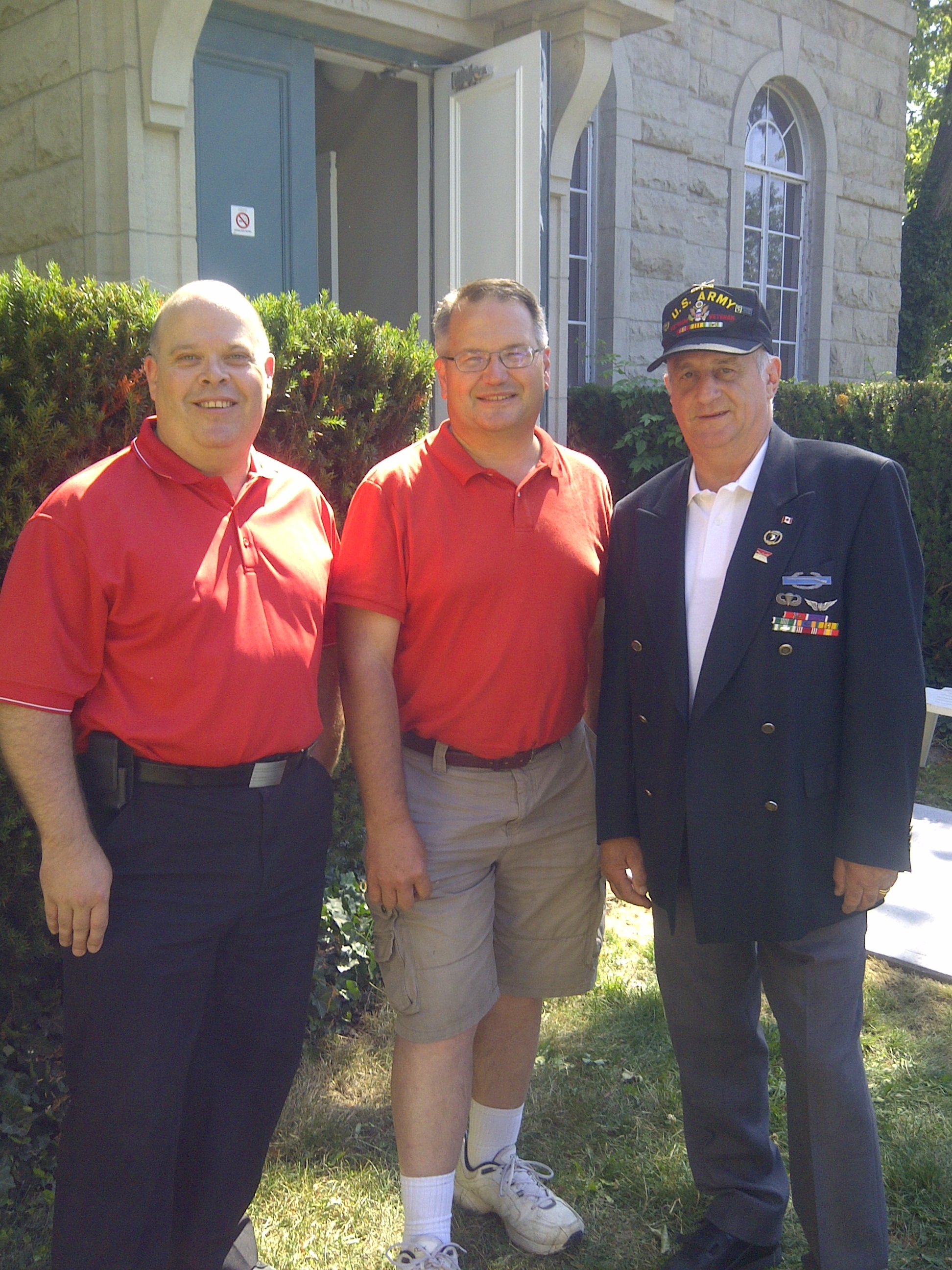
Pictured here on Canada Day Veterans Breakfast are yours truly, Regional Councillor Colin Best and fellow councillor and Vietnam veteran Rick Malboeuf.

Lest we forget.

Navigating Through The Fog – Part 3 of 4

Unlocking autism mystery with diet, programs

Part three of the four-part Metroland series, Navigating Through the Fog

ERIC RIEHL / OAKVILLE…

Somewhere in Ontario, a child would rather line up his toy cars than navigate them through an invisible maze.

Somewhere in Ontario, a mother looks at her child and instinctively wonders. A doctor tells a father they should wait and see.

Somewhere in Ontario, the diagnosis is confirmed — autism spectrum disorder (ASD).

Approximately one in every 100 children lives with autism, a neuro-developmental spectrum disorder that impedes a person’s ability to communicate and make friends.

Statistics indicate about one per cent of the population is on the spectrum. In Hamilton, some 5,000 individuals are caught in its fog.

The cause of the disorder remains unknown, but researchers believe the secret is in the genes. With no cure for autism, families affected by the disorder have turned to a variety of therapies that have proven successful in alleviating its wide-ranging symptoms. But accessing help is easier said than done.

This is the third of a four-part Metroland series, Navigating Through the Fog, that attempts to piece together the puzzle of autism.

• • •

Autism spectrum disorder is shrouded in mystery. Scientists have uncovered genetic links associated with the condition, which affects one in roughly 100 individuals living in the community; yet, no definite cause has been identified.

Despite the fog that envelops autism, interesting trends have emerged. These developments have allowed medical professionals to take different approaches when attempting to quell the disorder’s symptoms, which manifest themselves physiologically and developmentally.

For the parents, caregivers and those living with autism, headlines like “Baby communication gives clues to autism; High-tech tools created to study autism; Little evidence supports medical treatment options for adolescents with autism and Children with autism experience interrelated health issues” offer hope, advice and opinions. There are new studies and choices every day. Play-based and natural therapies, new apps or the latest tech-gadgets — the options are limitless.

A BIOLOGICAL ISSUE?

Dr. Sonya Doherty, a licensed and board certified naturopathic doctor who specializes in neuro-developmental disorders including autism, has zeroed in on her patients’ biochemistry and metabolic function to develop treatment modalities.

“What I believe, and what research is now supporting, is that autism is indeed a biological issue,” said Doherty, who operates her practice at Burlington’s The Natural Care Clinic.

Her biomedical treatments, which are partly covered by extended health benefits, have proven extremely successful among high- and low-functioning youth on the spectrum, targeting underlying impairments in physiology.

“If you can identify it, you can help them improve their quality of life and their developmental functioning,” she said.

There are many schools of thought on autism therapies and Doherty readily concedes her approach is far from mainstream, but effective nonetheless.

Just ask Ana Bejarano, a Milton mom of two boys, one with autism and another with pervasive developmental disorder (PDD), a condition that causes delays in development, socialization and communication. She turned to The Natural Care Clinic after numerous attempts to personally address her children’s behaviour and sensory issues as she and her husband did not have the financial means to fund intensive behavioural intervention (IBI), a series of therapies that can cost families tens of thousands of dollars annually.

Despite her efforts to implement a rigorous program in her home, she watched as her eldest son, Lucas, spiralled out of control.

“He was getting worse by the minute,” she said.

Lucas, who was three and a half at the time, was staring into space, barely slept and engaged in very rigid types of play. At times, he became aggressive, throwing objects in Bejarano’s path.

“I felt like I was a prisoner of autism,” she said. “It’s like I’m drowning and I can’t reach my son.”

EARLY WARNING SIGNS

On an interminable wait list for access to publicly-funded behavioural therapy, Bejarano was desperate for help for Lucas and his younger brother, Adrian, who was starting to exhibit some early warning signs.

In addition to his erratic behaviour, Lucas was suffering from bloody stools and chronic gastro-intestinal issues – symptoms reflecting a relatively new finding that links the brain’s development and problems with the gut.

“Up to 85 per cent of children with autism have digestive problems, severe constipation, severe diarrhea, even mucus and blood,” said Doherty.

Medical professionals often dismiss the digestive problems experienced by children on the spectrum as part and parcel of the disorder. “I hear this a lot and it’s just devastating,” said the naturopathic doctor.

Doherty’s non-conventional approach to using the body’s physiology as a roadmap to treating symptoms of autism is gaining popularity among families. But the process of replenishing the body of nutrients and vitamins, as well as eliminating items from one’s diet, is no child’s play.

For Bejarano’s boys, Doherty recommended a gluten- and dairy-free diet, a healthy dose of natural supplements and regular methyl B12 injections.

Altering Lucas’s diet “was the most difficult thing I have ever done,” said the Milton mom. The pre-schooler was a fussy eater, so much so that his diet consisted of only 11 items, including gallons of milk and spoonsful of ketchup.

Bejarano struggled with the nutritional regimen until she started looking at food differently. “I started to give him food like medicine,” she said.

Within a couple of months, Bejarano and her husband, Antonio Herrera, saw changes in Lucas’s behaviour and overall health. “He was actually coming alive,” she said.

The progress was also noticeable in Adrian, who also followed the same treatment plan for his PDD.

In Burlington, Lizanne Rowe’s son, Jack, experienced great success with biomedical treatment after he was diagnosed with autism at three and a half years. The family’s first plan of action was to consult with Dr. Doherty.

“We saw immediate results,” said Rowe.

Jack, too, was introduced to a gluten- and dairy-free diet, was provided with supplements and continues to receive methyl B12 injections, or as he calls it “his bum shot.”

Within a month, Jack had an explosion of language and a few months after that, began establishing eye contact with others. His tummy aches and other gastro-intestinal troubles subsided and his behaviour improved dramatically.

The changes in diet and nutrition were a family affair for the Burlington clan. Now, seven-year-old Jack shies away from foods loaded with gluten. “If we say, ‘That has gluten,’ he genuinely doesn’t want it because he knows that’s going to hurt his tummy,” said Rowe.

Methyl B12 injections, used to reactivate the biochemical pathways used to power up the brain, have also become part of Jack’s routine. And if he doesn’t receive his dose on time, his behaviour starts to shift. The youngster will even ask to have a “poke.” He feels himself slipping away back into the fog.

According to Doherty, much of the methodology used to treat autism has a direct impact on a child’s quality of life.

“For me, it’s almost a human rights issue,” she said. “If kids can’t sleep, they are sick all the time, they have terrible diarrhea, they have terrible digestion, then how can we expect them to learn and assimilate information so they can gain as many skills as possible?”

When Bejarano considered taking an alternative approach to treat her sons, her physician cautioned her.

“My doctor said, don’t be doing any voodoo stuff. That voodoo stuff has saved my life,” she stated.

There are other alternatives to intensive behavioural intervention, the traditional approach to autism therapy. One of those choices is the Oakville Success Centre.

The first of its kind in Canada, the new business provides psycho-educational therapy for people with dyslexia, attention deficit disorder, learning disabilities, autism and Asperger’s syndrome.

Cathy Dodge Smith, the centre’s director, uses the Davis Autism Approach, a non-invasive gentle method designed to allow autistic individuals to participate more fully in life. The approach, she said, draws autistic individuals out of the fog and into the real world.

Dodge Smith is stunned by the results of the program, which are relatively unknown in Canada. “It is like watching miracles unfold before my eyes,” she said. “During the first part of the program, I begin to see glimpses of the real person behind the autism mask.”

Working one-on-one with the autistic person, Dodge Smith said most intervention is behavioural, but this is not.

“We are teaching the individual how to be oriented,” she said. “At its core, (autism) is disorientation. They’re in their own little world.”

The director teaches them how to be fully present in the world – here and now. They come to understand how the world works and how they fit into it. Dubbed “individuation,” it allows the individual to build a perception of their senses to build a stronger awareness of self.

After undergoing a 30-hour week of therapy, the individual returns two weeks later for one-on-one treatments. Usually, Dodge Smith said, it’s as four-week program. She teaches sequencing, the importance of order, the ability to understand priorities.

“Whatever they want in their state, this allows them to begin thinking with these concepts,” said Dodge Smith, the former George Brown College Children’s Centre department head with more than 40 years of experience in special education and psychology. “There’s before and after, and the sequence didn’t make sense before (without the Davis approach).”

Modelling using white clay, Dodge Smith works with autistic people to explore the real world. It builds on a greater understanding of the world, which in turn strengthens identity and understanding.

“The white clay figures we make allow them to look at the world around them,” Dodge Smith explained, noting parents and caregivers are also included in the approach so they can learn to use it at home. “For them, the world is all about them. They’re not able to process that other people have needs.”

Through social integration, she is able to show an autistic person how the world works, how relationships work.

“That’s a huge block for them and they don’t get it… what do you need in relationship to another.”

Social integration is the third step in the Davis Autism Approach and its key concepts are the foundation of human relationships. These are worked on through clay modelling and can be built on, depending on an individual’s needs, she added.

Dodge Smith, 68, is a certified Davis facilitator, having trained under the program’s founder Ronald Davis. Davis has been working with autistic individuals for 30 years. The New Zealand man created the program and a small group of “Davis facilitators,” including Smith, are teaching it around the world.

She shared the positive outcomes of some of the Oakville Success Centre’s clients, including a 26-year-old female who was “a mess… on drugs, booze, and her parents thought they’d be supporting her forever.”

After completing the program, she has held a job, is off drugs and alcohol and experienced “a total turnaround,” Dodge Smith said. “She learned how to work with people, just by being here and being visible.”

The treatment is pricey at $3,600 per week and is not covered by any medical plans. Still, Dodge Smith stands firmly behind her work, in fact she came out of retirement to open the Oakville Success Centre.

“Sometimes it takes three to four weeks, but I’ve never heard of any individual that didn’t work out,” she said.

Oakville’s Peter and Elaine Rose placed their nine-year-old son Larry in the program and were pleased with his success.

“I honestly don’t think we would be achieving the success we have so far without Cathy and the Davis Autism Approach program,” Elaine said. “It played a huge part in helping my son to interact socially within his environment. He would not be in a regular class in school without it.”

Halton Region Announces 311 Service

Halton launches 311 service

Halton Region is making it easier for residents to connect to programs and services.

It has launched the 311 non-emergency service online, which allows residents to find, pay, register, report or request services from the Region, Halton Regional Police, or local municipalities.

Residents can now either dial 311 or visit www.halton.ca/311 to access all eight Halton government partners (Regional and local municipal governments, Halton Regional Police Service, Halton District School Board and Halton Catholic District School Board) and find out more about recycling and waste pick-up or register for parenting or parks and recreation programs.

Customer Service is a priority of Halton Region’s Citizens’ Priorities (2011-2014) Action Plan. Last year, more than 290,000 residents called Access Halton for information about programs and services.

What is 311?

  • 311 is an easy-to-remember, three-digit, non-emergency telephone number that offers a single window of direct access to Halton government services.
  • 311 provides free, multilingual assistance to anyone calling from within Halton.
  • It allows citizens to request a service or receive general information.

Whose services can I access by dialing 311?

  • Halton Region
  • City of Burlington
  • Town of Halton Hills
  • Town of Milton
  • Town of Oakville
  • Halton District School Board
  • Halton Catholic District School Board
  • Halton Regional Police Service (non-emergency calls)

Why do we need 311?

  • 311 means you don’t need to know which Halton government provides a particular service. You don’t have to sort through dozens of telephone numbers to find the people you need to talk to.
  • 311 also provides an easy-to-remember telephone number for non-emergency police calls which will reduce the burden of non-emergency calls made to 9-1-1.

How does 311 work?

  • 311 calls will be answered by customer service representatives in Access Halton.
  • While 311 is a program of Halton Region, callers will be able to access the programs and services provided by any of the eight partner organizations:
    • Regional and Local Municipal governments
    • Halton Regional Police Service
    • Halton District School Board
    • Halton Catholic District School Board
  • The customer service representatives will use a powerful database of about 1,500 records to respond to your inquiries on a vast array of Halton government services.

What are some examples of 311 calls?

  • reports of potholes
  • questions on site plan applications
  • location and hours of libraries
  • requests to register for parks and recreation programs
  • complaints about parking bylaw infractions
  • reports of stolen property after an event has occurred
  • requests to hire police officers for special events
  • reports of motor vehicle accidents
  • queries on police security checks
  • reports of suspected food poisoning
  • queries about well water
  • requests to book travel health clinic appointments
  • reports of dog bites
  • requests for financial assistance
  • queries on child development
  • queries on road construction projects
  • reports of sewer backup
  • reports of missed garbage collection
  • queries on acceptable items for recycling

What are the hours of operation?

  • You can dial 311 any time and speak to a live person.
  • Regular business hours of 8:30 am to 4:30 pm.
  • After regular business hours, only those of an urgent nature will be handled.

Will 311 work from cell phones, payphones, etc.?

  • Yes.

Can I still call the city or town directly using the ten digit number I have previously used to reach them?

  • Yes, and if you know the name of the person you wish to speak to, you should always call the ten-digit numbers.